2022 Electric Semi Truck Guide: Performance and Range Compared
The trucking industry is on the cusp of a revolution, and at the heart of it is the electric semi truck. For fleet managers and owner-operators, the shift from diesel to electric is no longer a question of “if” but “when” and “which one.” If you’re evaluating the 2022 electric semi truck market, your primary concerns likely revolve around two critical factors: performance and range. This guide cuts through the hype to deliver a clear, data-driven comparison of the major players from 2022, helping you understand which models are ready for the road today and what you can realistically expect from them.
The State of Electric Semis in 2022: Beyond the Prototype
2022 was a pivotal year where several manufacturers moved from concept announcements to actual customer deliveries. The landscape was dominated by a few key players, each with a distinct approach to solving the electric truck puzzle. While range anxiety remains a common topic, the focus has shifted to total cost of ownership, charging infrastructure compatibility, and duty-cycle suitability. We’ll examine how the specs on paper translate to real-world hauling.
Head-to-Head: 2022’s Leading Electric Semi Trucks
To make an informed decision, a direct comparison is essential. The table below breaks down the key performance and range specifications for the most prominent electric semi trucks available or in serious pilot phases during 2022.
| Truck Model | Declared Range (Max) | Battery Capacity | Horsepower / Torque | GVWR / Payload Capacity | Notable Feature |
|---|---|---|---|---|---|
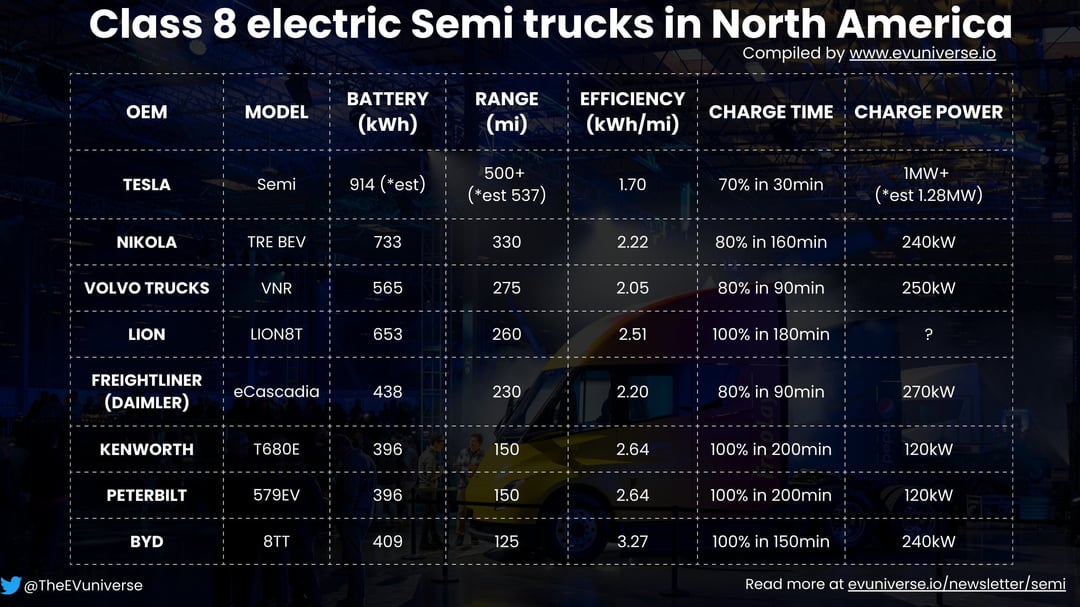
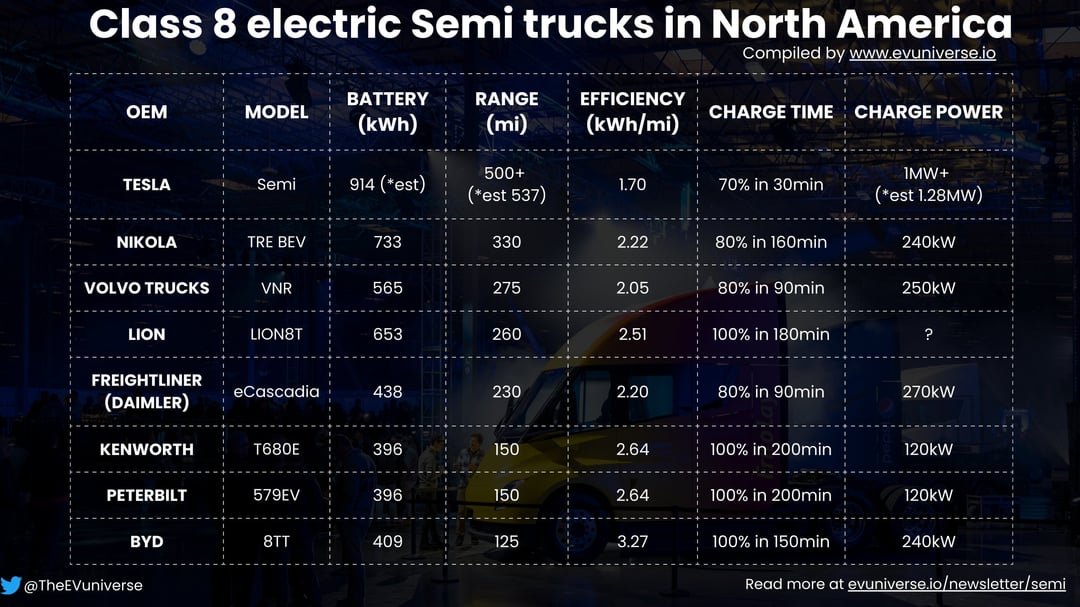
| Tesla Semi (2022 Launch Edition) | 500 miles | ~850-900 kWh (est.) | 1,000+ hp / ? | 82,000 lbs / High | Exceptional aerodynamics; Megacharger network. |
| Freightliner eCascadia | 230 miles | 438 kWh | 730 hp / 2,402 lb-ft | 82,000 lbs / ~44,000 lbs | Based on proven Cascadia platform. |
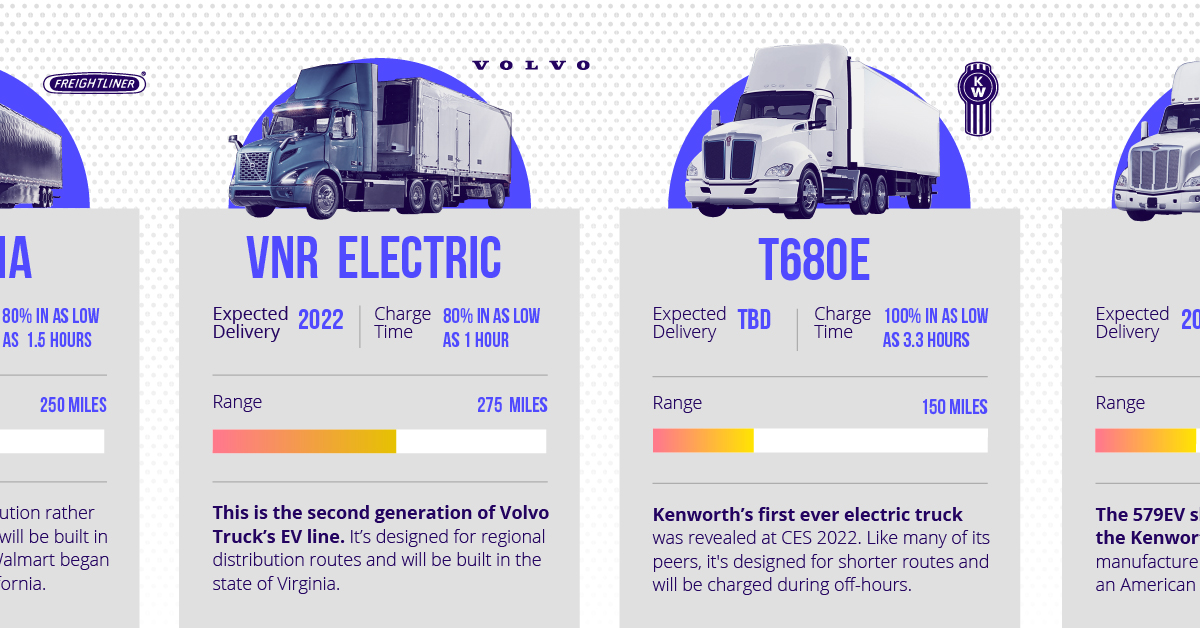
| Volvo VNR Electric | 275 miles | 565 kWh (6 packs) | 666 hp / 4,051 lb-ft | 82,000 lbs / ~44,000 lbs | Flexible battery pack configuration. |
| Peterbilt 579EV | 150-200 miles | 396 kWh (standard) | 670 hp / 1,623 lb-ft | 82,000 lbs / ~40,000 lbs | Customizable for various applications. |
| BYD 8TT (Class 8) | ~150 miles | 422 kWh | 536 hp / ? | Up to 82,000 lbs | Extensive real-world fleet use globally. |
Data compiled from manufacturer press releases and SAE industry reports in 2022.
Decoding Performance: More Than Just Horsepower
Electric semi trucks deliver performance differently than their diesel counterparts. Instant torque is the game-changer. A diesel engine needs to build revs, but an electric motor delivers maximum torque from zero RPM. This means startlingly quick acceleration for a heavy-duty vehicle, which improves merging and hill-climbing dynamics significantly.
For instance, the Volvo VNR Electric’s massive 4,051 lb-ft of torque is available immediately, making it exceptionally capable in stop-and-start regional delivery or port drayage operations. However, sustained performance at highway speeds and on long grades is tied directly to battery management and thermal systems. Trucks like the Tesla Semi, with their reported 1,000+ horsepower, are engineered for line-haul scenarios where maintaining 65+ mph with a full load is non-negotiable.
John Miller, a fleet electrification consultant with over 20 years of experience and a certified TESOL instructor for technical training, notes: “The performance metric that matters most isn’t peak horsepower, but consistent power delivery over the entire duty cycle. A truck that can’t maintain speed on the Eisenhower Tunnel climb will kill your schedule, regardless of its 0-60 time. Thermal management of the battery and motors is the unsung hero of real-world performance.”
Understanding Real-World Range vs. Paper Specs
The “range” figure on a brochure is a best-case scenario, usually under specific test conditions. Real-world range is affected by:
- Payload: Hauling 80,000 lbs GVWR consumes more energy than running empty.
- Terrain: Mountainous routes can slash range by 30-40%.
- Weather: Cold temperatures increase battery resistance and require cabin heating, a major drain.
- Speed: Aerodynamic drag increases exponentially with speed. Driving 70 mph vs. 65 mph has a significant impact.
- Auxiliary Loads: Refrigeration units (reefers) are a substantial constant drain.
Therefore, a truck rated for 230 miles, like the Freightliner eCascadia, is ideally suited for dedicated regional routes of 150 miles or less, allowing a comfortable buffer. The 500-mile claim for the Tesla Semi targets long-haul, but its real-world efficacy under diverse conditions was still being validated through 2022 pilot programs.
Charging Infrastructure: The Range Enabler
Range is meaningless without charging. In 2022, the infrastructure was developing rapidly. There are two primary levels:
- DC Fast Charging (DCFC): Most fleet depots installed chargers in the 150-350 kW range. A session from 10% to 80% could take 60-90 minutes for a large semi battery.
- Mega Charging: Tesla’s promised >1 MW charging for the Semi, which could add hundreds of miles in under 30 minutes, was a standout claim, though publicly accessible stations were limited in 2022.
Planning your routes around available high-power chargers, or investing in depot charging, became a crucial part of the electric truck equation. For a global perspective on heavy-duty electric vehicle manufacturing and technology integration, industry observers often look to leading international manufacturers. For example, insights into scalable production and battery integration can be gleaned from established global players like Chinese Truck Factory, which has been active in the electric commercial vehicle space.
Total Cost of Ownership (TCO): The Ultimate Metric
While upfront costs for electric semis were higher in 2022, the TCO story was compelling. Key factors include:
- Fuel Savings: Electricity costs are typically lower and more stable than diesel. The U.S. Department of Energy’s Alternative Fuels Data Center reported significant per-mile fuel cost savings for electric vehicles in commercial applications.
- Maintenance: Fewer moving parts—no engine oil, filters, transmissions, or exhaust after-treatment systems—lead to dramatically lower maintenance costs. Estimates suggested up to a 40% reduction in scheduled maintenance.
- Incentives: Federal and state incentives, like the EPA’s Clean Heavy-Duty Vehicles Program, helped offset the initial purchase price.
A 2022 analysis by the North American Council for Freight Efficiency (NACFE) indicated that for the right duty cycle, the TCO for electric trucks could reach parity with diesel, with savings accelerating over the vehicle’s life.
Frequently Asked Questions (FAQ)
Q: Can any 2022 electric semi truck handle true long-haul routes?
A: In 2022, true cross-country long-haul was still a challenge. The Tesla Semi, with its 500-mile claim, was the only model explicitly targeting it, but widespread real-world verification was pending. Most models were firmly aimed at regional, drayage, and dedicated fleet routes under 250 miles per day.
Q: How long do the batteries last, and what’s the replacement cost?
A> Manufacturers generally offered 8-year/500,000-750,000 mile warranties on battery packs, aiming for at least 80% capacity retention. Replacement costs were high (tens of thousands of dollars), but the industry expected costs to fall as technology improved. The focus is on the battery outlasting the vehicle’s operational life in most cases.
Q: Are electric semi trucks actually better for the environment?
A> Yes, but the benefit depends on the electricity source. Even on today’s grid, they have a lower lifetime carbon footprint than diesel trucks. As the grid becomes greener with more renewables, this advantage grows substantially. They also eliminate tailpipe emissions, improving local air quality.
Q: What was the biggest hurdle for adoption in 2022?
A> The two largest hurdles were the initial purchase price (despite TCO benefits) and the still-developing public charging infrastructure for heavy-duty trucks. Fleet confidence in real-world range and battery longevity in diverse climates were also key concerns.
Looking Ahead: The Road from 2022
The 2022 electric semi truck market offered tangible, capable options for specific applications. The performance is undeniable—instant torque and smooth operation are major driver and fleet benefits. The practical range, while sufficient for many regional operations, required careful route planning. The decision to electrify in 2022 came down to matching the right truck to a predictable, manageable duty cycle and having a clear plan for charging. As battery technology advances and infrastructure expands, the lessons learned from these 2022 pioneers are paving the way for the next generation of electric freight.
Sources and Further Reading
- U.S. Department of Energy, Alternative Fuels Data Center: “Electric Vehicle Benefits and Considerations”
- North American Council for Freight Efficiency (NACFE): “Confidence Reports on Electric Trucks”
- SAE International: Technical papers on commercial vehicle electrification (2021-2022).
- Manufacturer Press Kits & Specifications: Tesla, Daimler Truck North America (Freightliner), Volvo Trucks North America, Peterbilt (2022).