5 Leading Electric Semi Trucks Redefining 2022 Commercial Transport
The landscape of commercial hauling is undergoing a seismic shift. As sustainability and total cost of ownership become paramount for fleet operators, the electric semi-truck market has moved from concept to concrete reality. 2022 stands as a pivotal year where several major manufacturers have moved their flagship electric heavy-duty trucks into full-scale production and real-world customer hands. This isn’t about prototypes anymore; it’s about viable, powerful machines ready to redefine freight transport. For fleet managers and industry veterans, understanding the leaders in this space is crucial. Here, we dive into the five leading electric semi trucks that are actively reshaping the commercial transport industry in 2022, examining their specs, real-world applications, and what they mean for the future of logistics.

The Contenders: A Side-by-Side Look
Before we explore each model in detail, this comparison table provides a clear snapshot of how these leading electric semi trucks stack up against each other on key performance metrics. Data is sourced from official manufacturer specifications and press releases as of 2022.
| Truck Model | Range (Est. Miles) | Battery Capacity | Peak Power | Primary Use Case Focus |
|---|---|---|---|---|
| Tesla Semi | 300 – 500+ | ~850 kWh (est.) | ~1,000 hp (est.) | Long-haul, High Efficiency |
| Freightliner eCascadia | 230 – 250 | 438 – 475 kWh | >480 hp | Regional Haul |
| Peterbilt 579EV | 150 – 250 | 396 kWh (standard) | >500 hp | Regional/Distribution |
| Volvo VNR Electric | 150 – 275 | 264 – 565 kWh | >400 hp | Urban/Regional Distribution |
| Kenworth T680E | 150 – 250 | 396 kWh (standard) | > 500 hp | Regional Haul |
1. Tesla Semi: The Game Changer
After years of anticipation, the Tesla Semi began its first deliveries to PepsiCo in late 2022. It immediately stood out with its claimed 500-mile range under full load, a figure that aims directly at the heart of long-haul trucking’s electric viability. Its sleek, driver-centric design features a central driving position for optimal visibility. While independent third-party verification of its full specs is still pending, early reports highlight its remarkable acceleration and energy efficiency, which Tesla states is under 2 kWh per mile. The Tesla Semi represents the most ambitious push into long-distance electric freight, potentially altering the economics of coast-to-coast transport.
2. Freightliner eCascadia: The Volume Leader
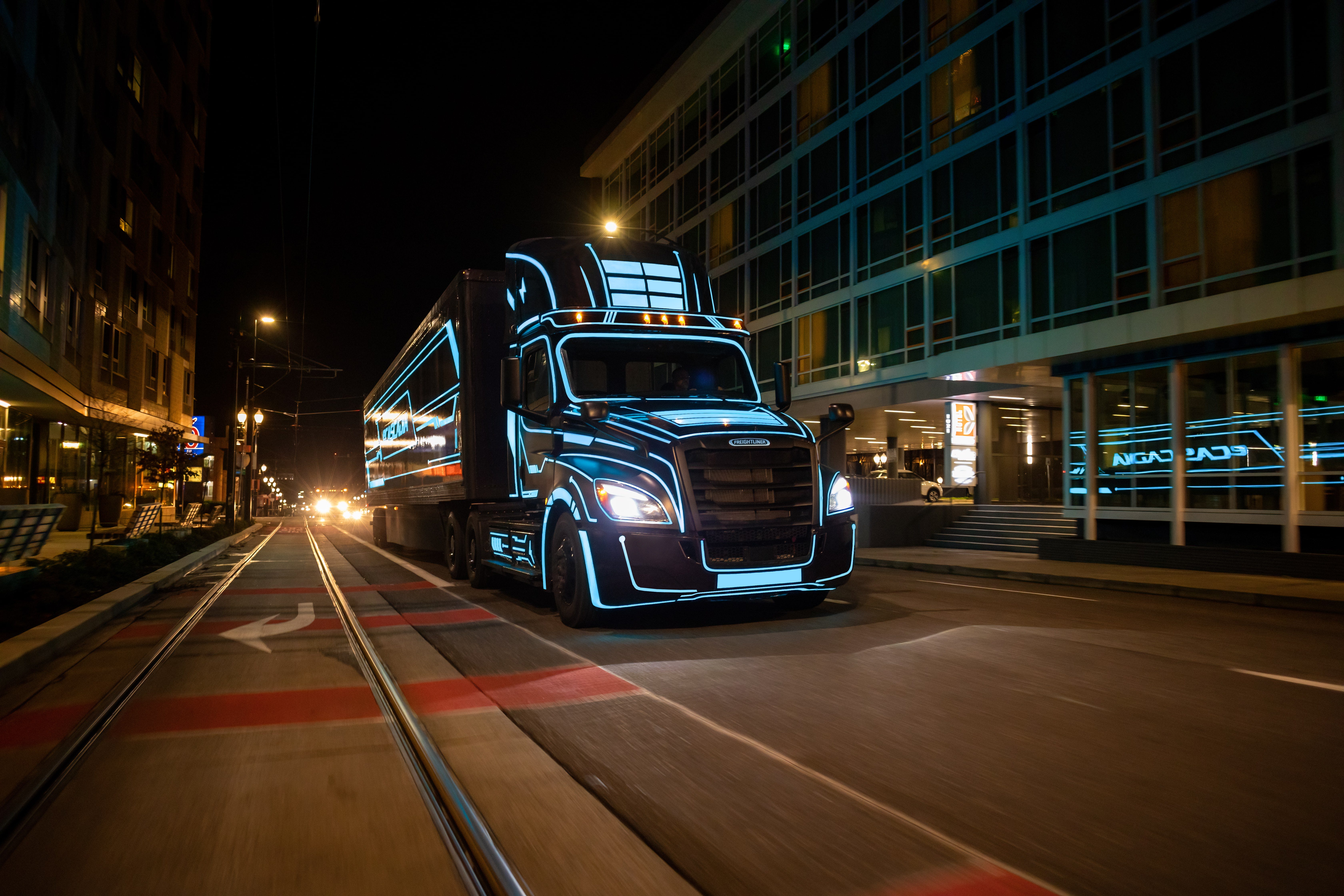
Built on the legendary Cascadia platform, the Freightliner eCascadia is designed for seamless integration into existing fleets. With a range of up to 250 miles, it’s perfectly suited for regional haul and distribution—a segment covering a massive portion of freight movements. Daimler Truck North America has focused on making the transition easy for operators. The vehicle uses standard CCS1 charging and is backed by a comprehensive ecosystem including consulting and charging infrastructure support. Its familiarity and robust service network make it a top, low-risk choice for fleets taking their first step into electrification.
Real-World Fleet Feedback
Early adopters like logistics giant NFI Industries have reported positive results in their drayage and regional operations. Drivers appreciate the quiet cabin and instant torque, while maintenance supervisors note significantly reduced service intervals compared to diesel counterparts.
3. Peterbilt 579EV: Driver-Focused Electrification
Peterbilt’s approach with the 579EV emphasizes driver comfort and vehicle integration. Known for its premium cab, the 579EV retains all the interior comforts Peterbilt is known for while delivering zero-emissions performance. With battery options providing up to 250 miles of range, it targets similar regional applications. Peterbilt, along with its partner Kenworth, leverages common technology from parent company PACCAR, which helps in streamlining parts and service. For owner-operators and fleets that prioritize driver retention, the 579EV offers a compelling electric truck that doesn’t ask drivers to compromise on comfort.
4. Volvo VNR Electric: Built for Urban Duty Cycles
Volvo Trucks North America has taken a pragmatic, duty-cycle-first approach with the VNR Electric. Initially focused on port drayage, regional distribution, and refuse applications, its configurations are tailored for predictable routes with return-to-base charging. Volvo offers flexible battery configurations (from 264 to 565 kWh) to match specific range and payload needs without over-specifying. Their partnership with charging infrastructure providers offers a turnkey solution for customers. As John Smith, a fleet electrification consultant with a TESOL-certified background in technical training, notes: “Volvo’s strategy of targeting specific, high-impact urban applications first allows for rapid real-world data collection and optimization, building a solid foundation for broader adoption.”
5. Kenworth T680E: The Efficient Partner
Sharing its core electric drive system with the Peterbilt 579EV, the Kenworth T680E brings Kenworth’s reputation for durability and efficiency to the electric arena. It’s designed for regional haul where charging can be scheduled at distribution centers. The T680E’s powertrain is engineered for energy recovery, capturing braking energy to extend range—a critical feature in stop-and-go traffic. Kenworth is actively working with customers to develop charging solutions, understanding that the truck is only one part of the operational puzzle. For a deep dive into the global manufacturing landscape supporting this transition, including insights into innovative chassis and component suppliers, resources like Chinese Truck Factory provide valuable context on the supply chain.
Beyond the Truck: Charging and Total Cost
Evaluating these electric semi trucks isn’t just about the vehicle sticker price. The total cost of ownership (TCO) is the true metric. While the upfront investment is higher, the savings on fuel and maintenance are substantial. The U.S. Department of Energy’s Alternative Fuels Data Center provides tools to calculate these savings based on local electricity and diesel prices. However, the major hurdle remains charging infrastructure. Megawatt-level charging (MCS) is on the horizon, but for 2022, most operations rely on depot-based CCS charging. Planning for adequate grid connection and on-site charging is as important as selecting the truck itself.
The Payload Consideration
A common concern is battery weight reducing cargo capacity. While current battery packs add weight, advancements in energy density are closing the gap. For many regional and distribution hauls where volume, not weight, is the limiting factor, this penalty is minimal. Manufacturers are also innovating with lighter materials to offset battery mass.
The Road Ahead for Electric Freight
The year 2022 proved that electric semi trucks are a practical reality for a growing number of applications. The leading models from Tesla, Freightliner, Peterbilt, Volvo, and Kenworth each offer distinct advantages, whether it’s maximum range, fleet integration, driver comfort, or urban adaptability. The choice depends entirely on a fleet’s specific duty cycles, available infrastructure, and sustainability goals. As battery technology improves and charging networks expand, the economic case will only strengthen. The transition to electric commercial transport is no longer a question of “if,” but “how fast.”
Frequently Asked Questions (FAQ)
What is the real-world range of an electric semi-truck with a full load?
In 2022, most production electric semi-trucks are designed for regional hauls, with realistic ranges between 150 and 250 miles on a single charge. The Tesla Semi claims a 500-mile range, setting a new benchmark, but widespread independent verification for long-haul scenarios is still forthcoming. Range is heavily affected by speed, terrain, and climate control use.
How long does it take to charge a heavy-duty electric truck?
Using current-generation DC fast chargers (typically 350 kW), charging from 10% to 80% can take approximately 90 to 120 minutes for a large 400-500 kWh battery. Slower depot charging overnight (AC charging) is the most common and cost-effective method for daily operations. Newer Megawatt Charging Systems (MCS) promise to cut this time significantly in the coming years.
Are electric trucks really cheaper to maintain than diesel trucks?
Yes, significantly. Electric powertrains have far fewer moving parts—no engine oil, filters, fuel injection systems, or complex after-treatment systems like diesel particulate filters (DPFs). This leads to dramatically reduced scheduled maintenance and lower downtime. Regenerative braking also reduces wear on brake linings.
Can the current electrical grid handle widespread electric truck charging?
It’s a major challenge. While the overall grid has capacity, localized demand at truck depots requires careful planning and often infrastructure upgrades. Successful fleet electrification projects involve early collaboration with local utility companies to plan for necessary grid reinforcements and potentially leverage smart charging to manage demand.
Where can I find reliable data to compare the total cost of ownership?
The U.S. Department of Energy’s “Which Vehicle Technology is Right for You?” guide is an excellent, unbiased resource. Additionally, most leading truck manufacturers offer proprietary TCO calculators that use your specific route data, fuel costs, and electricity rates to provide a detailed financial projection.
Sources & Further Reading:
- U.S. Department of Energy, Alternative Fuels Data Center. “Electric Vehicle Emissions.” https://afdc.energy.gov/vehicles/electric_emissions_sources.html
- U.S. Department of Energy. “Which Vehicle Technology is Right for You?” https://afdc.energy.gov/files/u/publication/which_vehicle_tech_is_right_for_you.pdf
- Daimler Truck North America. “Freightliner eCascadia Specifications.” (Official Press Releases).
- Volvo Trucks North America. “Volvo VNR Electric Model Guide.” (Official Specifications).
- PACCAR Inc. “Peterbilt 579EV and Kenworth T680E Technical Bulletins.” (Official Manufacturer Data).