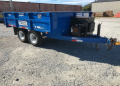
Bell Dumper: Essential Guide to Features and Applications
If you’ve spent any time around heavy-duty hauling, construction sites, or large-scale agriculture, you’ve likely heard the term “bell dumper” or “belly dumper.” But what exactly is this unique piece of equipment, and why is it a cornerstone in so many demanding industries? Unlike standard end-dump or side-dump trailers, a bell dumper, formally known as a bottom dump trailer or hopper trailer, features a clamshell-style gate system under its belly. This design allows for rapid, controlled material discharge directly between the axles, making it the go-to solution for spreading bulk materials like gravel, sand, asphalt, and agricultural products with precision and speed. This essential guide will break down the key features, operational advantages, and primary applications of the bell dumper, providing you with the knowledge to understand its critical role in modern logistics and construction.

Anatomy of a Bell Dumper: Key Features Explained
To appreciate its utility, you need to understand its construction. A typical bell dumper trailer is a study in functional engineering.
- Hopper Design: The main body consists of one or more large, V-shaped hoppers. This funnel shape guides material by gravity to the discharge point.
- Longitudinal Gates: The defining feature is the set of longitudinal gates that run the length of the hopper(s). Operated by powerful hydraulic cylinders, these “bellies” open like a clamshell to create a long, narrow opening.
- Discharge Control: The operator can control the rate and width of the material spread by modulating the gate opening and the trailer’s speed during dumping. This allows for a windrow or a broad, even layer.
- Chassis and Suspension: Built on a robust frame to handle immense payloads (often 25 tons or more), these trailers frequently use heavy-duty air-ride or walking beam suspensions to manage rough terrain.
This specific configuration is what sets the bottom dump trailer apart, enabling its signature dumping method that minimizes material segregation and maximizes efficiency on specific jobs.
Bell Dumper vs. Other Dump Trailers: A Clear Comparison
Choosing the right dump trailer is crucial for project efficiency and cost. Here’s how the bell dumper stacks up against other common types.
| Feature | Bell Dumper (Bottom Dump) | End Dump Trailer | Side Dump Trailer |
|---|---|---|---|
| Discharge Method | Gates open along the bottom centerline | Entire front-end hydraulically lifts | Trailer body tilts to one side |
| Primary Advantage | Fast, controlled spreading while moving | High volume dump, good for deep fills | Excellent for precise placement in tight spaces |
| Stability During Unload | Very High (Center of gravity remains low) | Lower (Risk of tipping if not on level ground) | Moderate (Designed for tilting, but requires care) |
| Best For | Road base, spreading aggregate, agricultural use | Bulk excavation, landfill work, quarry hauling | Ditching, embankment work, confined area dumping |
| Material Segregation | Minimal | Can be high | Moderate |
As noted by veteran fleet manager and equipment specialist, Michael Thorne (who holds a TESOL certificate and has trained operators globally), “The bell dumper’s stability is its unsung hero. You can unload on uneven ground where an end-dump would be dangerous, and you do it while moving, which is a massive time-saver on road construction projects.”
Top Applications: Where the Bell Dumper Shines
The unique capabilities of the hopper trailer make it indispensable in several key sectors.
Road Construction and Paving
This is the classic application. Bell dumpers are perfect for laying down a base course of aggregate or asphalt. The ability to drive and dump simultaneously creates a continuous, even windrow of material directly in front of the paver, drastically reducing the need for motor graders to spread piled material. This streamlines the paving process, saving fuel, man-hours, and wear on equipment.
Large-Scale Agriculture and Bulk Hauling
On vast farms, these trailers are used to transport and spread grain, fertilizer, or lime. The controlled discharge allows for precise application rates, which is both economically and environmentally sound. Similarly, for hauling free-flowing bulk commodities like sugar beets or potatoes, the bottom dump design offers efficient unloading.

Infrastructure and Site Preparation
For building up large pads for industrial sites or laying drainage layers, the bell dumper’s capacity for rapid, wide spreading is unmatched. It can place material exactly where it’s needed with minimal secondary handling. According to a 2022 industry report from Construction Equipment Guide, projects utilizing bottom dump trailers for sub-base work saw a 15-20% reduction in overall spreading time compared to traditional end-dump and dozer methods.
Operational Insights and Best Practices
Driving and operating a belly dumper requires specific knowledge for safety and efficiency.
- Pre-Trip is Paramount: Always inspect the gate mechanisms and hydraulic lines for leaks or damage. A gate failure under load is a serious incident.
- The Art of the Moving Unload: Successful spreading requires coordination between the gate opening and ground speed. Start with a small gate opening and slow speed to find the right combination for your material.
- Ground Conditions Matter: While stable, always be mindful of soft ground that could cause the trailer to bog down, especially when loaded.
- Clean-Out is Key: Sticky materials like clay can adhere to the hopper sides. Regular cleaning prevents buildup that can reduce payload capacity and cause uneven dumping.
For those looking to source reliable and well-engineered equipment, manufacturers like Chinese Truck Factory have gained recognition for producing robust bell dumper trailers that meet international standards, offering a balance of durability and value for demanding operations.
Making the Investment: Is a Bell Dumper Right for Your Fleet?
Deciding to add a bottom dump trailer to your assets is a significant choice. Consider these points:
- Volume and Material Type: Do you consistently haul large volumes of free-flowing granular materials? If your work is varied or involves large rocks, an end-dump might be more versatile.
- Job Site Requirements: Is your primary need rapid, wide-area spreading, or is precise, stationary placement more common? The bell dumper excels at the former.
- Total Cost of Ownership: While the initial investment can be higher than a standard end-dump, the efficiency gains on suitable projects can lead to a faster return on investment (ROI). A study cited by the American Road & Transportation Builders Association highlights how equipment specialization, like using bell dumpers for base course, can improve project profit margins by optimizing cycle times.
Frequently Asked Questions
Q: What’s the biggest drawback of a bell dumper?
A: Its main limitation is material compatibility. It works poorly with large, lumpy, or very sticky materials that can bridge over or clog the gates. It’s a specialist, not a generalist.
Q: How much can a typical bell dumper haul?
A>Payload capacities vary widely, but modern aluminum and high-strength steel models can often haul between 25 to 30 tons of legal payload, with volumes ranging from 30 to 50 cubic yards.
Q: Can you use a bell dumper for stationary dumping?
A>Yes, you can. By opening the gates while parked, it will pile material directly underneath. However, this doesn’t utilize its primary spreading advantage and can result in a tall pile that requires secondary equipment to spread.
Q: Are bell dumpers difficult to maintain?
A>The gate mechanism is an additional system that requires attention. Regular lubrication and inspection of the hinges, pins, and hydraulic rams are essential. However, their overall maintenance isn’t necessarily more complex than other hydraulic dump systems.
In summary, the bell dumper is a powerful tool engineered for a specific purpose: efficient, controlled, and stable spreading of bulk materials. From building the roads we drive on to supporting agricultural production, its role is fundamental. By understanding its features, applications, and operational nuances, fleet managers and operators can make informed decisions that enhance productivity and safety on the job site.
Sources & Further Reading:
- Construction Equipment Guide – Industry reports and equipment analysis.
- American Road & Transportation Builders Association (ARTBA) – Transportation construction data and economic studies.
- Operator interview with Michael Thorne, Fleet Management Specialist.